Showing posts with label Technical Stuff. Show all posts

Tuesday, October 2, 2012

Utah Ski Pick 2012 - Matt and Sven Pick Skis in Ogden

Park City, UT
Last week Matt Liebsch and I had the unique opportunity to pick Gear West's preseason orders of top end skis from Rossignol, Atomic, and Salomon. We arrived in Salt Lake City on Wednesday and hurried to get our bags and rental car. Matt made the executive decision to upgrade our car to an under-powered midsize SUV to accommodate all of our ski gear, and then we were on our way to the Rossignol Distribution center! But first, we had to stop at Taco Time!

The Rossignol Distribution center is part of a warehouse district located in Ogden, Utah.  Salomon and Atomic are also distributed in a nearby warehouse. Our high-end ski inventory is selected from these warehouses, as well as the skis for many of the top athletes in the country.

Rossignol distribution center
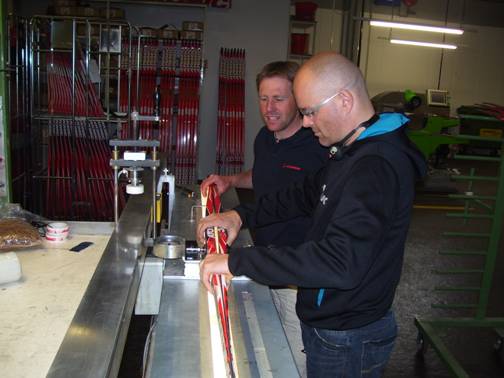
When we arrived, Ryan Green (Nordic Division Manager) and Paul Clark (Nordic Racing Manager) met us in the upstairs warehouse, I named the "The Birds Nest" to go over the lay of the land. We set up our fit bench and we were off to the races!

Matt & Paul conversing over proper ski fit
In order to select our full inventory of X-ium skis, we had a check list of characteristics we were looking for in terms of ski quality.  If any ski did not meet our requirements, it was discarded and we moved on. The next two days were spent unwrapping, flexing, and testing over 600 pair of skis.

Sven Cam
 After two days of squeezing skis, we wound up with very sore forearms, a slight case of carpal tunnel, and had thinned out our ski selection to 53 pairs of top quality skis. Both Matt and I were extremely happy with our selections and are grateful that we had the opportunity to select the best Rossignol skis in the United States.  We would not have been able to pick our inventory without the help from Rossignol.

Matt Pumped
Celebratory taco stand tacos were had by everyone!


Onward...

The very next day we were back in action, picking through the Atomic Worldcup FL SDS Classic skis and Salomon Soft Ground skate skis to find the best quality available.  When all was said and done, we had a sizable ski count with a high standard of quality.  It is safe to say that no stone was left unturned when we were done.

Fun fact: Atomic and Salomon skis only distribute race room skis from Ogden. 

Salomon SG ski inventory


New homeowners and newlyweds Josh & Kristina

While picking skis in Ogden, we had the privilege of staying with Salomon employees Josh Korn and Kristina Owen. All-in-all it was a very fulfilling experience. Thank you to everyone who made our ski picking trip a great success!

Monday, September 3, 2012

Mini Gear Preview

SDS stands for “short distance step”


We had the opportunity to test this ski early last February, and were immediately impressed by it's ability to provide phenomenal kick without compromising on glide. Atomic has achieved this with the use of a plate that runs the length of the ski's kick pocket. This plate is made of a very supple material called “ABS”, and is also featured in Atomic's extremely popular “Skintec” waxless classic race ski. The World Cup SDS has a relatively low camber, and the plate keeps the skiers weight lifted off the snow while gliding yet allows for an easy compression during the kick phase. If you are looking for a new classic ski this winter, we highly recommend this one.

Atomic WorldCup Skate And Classic Boots


 The Atomic WC Skate and Classic boots have been entirely redeveloped for the 2012-2013 season. The boots feature a new full 3D carbon chassis and carbon cuff that improves lateral stiffness over previous models.   A new wrapping lace system secures the foot and provides a very snug fit.  If you like the Salomon system and find the S-Lab boot too narrow, this is the boot for you. 


The new X-ium boot is 50 grams lighter than it's predecessor with a new 100% carbon fiber cuff, and new extremely low profile sole that brings your foot closer to the ski for improved control & responsiveness. This boot is also features asymmetrical lacing to keep your foot snug and secure, and is thermo-moldable for a fully customized fit.


Now built on the same last as the award winning carbonlite skate, this is by far the most comfortable classic boot Fischer has ever produced. This boot also features a new form-fitting upper, with a bold, fast graphic. This boot is available in both a men's and women's specific design.


Tuesday, July 31, 2012

My Fun Visit to Salomon France by Jan Guenther


Gear West Ski & Run has sold plenty of Salomon “S-LAB” products, however I had a limited idea of why the “LAB” title was placed on their top end products. Brian and I had the unique opportunity to visit Salomon’s design center in Annecy, France, just one hour outside Chamonix in the Alps. The Salomon ‘think tank’ is a fascinating study on how athletes, designers, researchers and engineers collaborate their efforts to invent super cool products.

After being in the ski business for twenty years I was very surprised to find there are still things that I do not know. For example, did you know there are 70+ pieces needed to construct a top race ski boot? Or that the cost of producing a larger foot mold to accommodate size 15+ feet is several hundred thousand dollars? Also, Salomon has every sponsored athlete’s unique foot mold, and can make one custom prototype at the design center for said athlete to use and provide instant design adjustments.

Pick your athlete
Another interesting fact I learned was the reason Salomon decided to to expand into trail footwear. After several winters of poor snow conditions, they decided something had to be done in order to continue and employ their seasoned pattern makers. For six months they developed a new concept for fit utilizing new materials along with existing Nordic foot technologies to design hiking shoes. The first pre-production boot was called the Adventure 7, these were used by  French Alpine Military specialists.


Inside Salomon’s  design center, sponsored athletes of all disciplines (downhill skiing, cross-country skiing, trail running, snowboard) work with a Salomon design team to bring new products to life and to redesign current products to meet their own personal needs. For example, ultra trail running phenom Killian Jornet was directly involved with the design process surrounding the heavily anticipated S-LAB Sense – a super light, low profile racing flat that has won several prestigious races, including the the Western States 100 and Ultra Trail Du Mont Blanc. Salomon Senior Project Manager Patrick Lieck put it this way, “the S-LAB process and products are primarily designed to enable athletes to win. But they are also a source of inspiration for the range. The next generation of products is based on these shoes (skis, boots, and poles).”

Killian dominating the Ultra-Trail du Mont-Blanc (UTMB)
What we saw throughout our tour of the design center was the spirit and excitement of a creative team inspired to design the best products for their athletes and challenged to produce it internationally for the consumer.  The Salomon building complex is truly a “LAB” that produces products tested right outside the center, on the snowy slopes of Mont Blanc and the mountain trails. 

For me, Salomon products now have more depth as I now understand the authenticity behind the development of an S-LAB shoe, ski, or boot. I am excited as a retailer to explain the hows and whys of the S-LAB classic boot, or what makes an Equipe 10 skate ski work so well, or why the Speedcross trail shoe is so much fun to own.  It’s this well designed and well thought out equipment that makes it so much fun to race, train or tour.

Monday, June 4, 2012

Gait Analysis By Lev

Two Thumbs Up!
As an avid cross country skier I spend a lot of time obsessing over technique and making myself as efficient as possible. It's staggering to compare the amount of time I spend cross training versus the amount of time actually spent on snow in the winter. I don't know about you, but besides rollerskiing the two cross-training activities I engage in the most are cycling and running. I decided that having a gait analysis with Lev would be beneficial, because becoming more efficient in the activities I enjoy 75% of the year will all in all make me a stronger, faster skier.


The Gait Analysis process takes about 30 or 40 minutes, and is based on your own personal goals. Many people use the information they receive for injury prevention, rehabilitation, and to determine a good shoe fit for their feet. That being said, if you are just starting to run or a seasoned competitor - everyone can benefit from this service. Lev starts off by taking some initial video footage of your running form, and administers some basic strength tests. He then demonstrates and helps you practice drills and exercises that help improve your running style. This is followed by a second video which you will view side by side with the initial footage. It is absolutely incredible to see the changes you are able to make in such a short span of time!

Lev goes over the finer points of Jenny's run form
Advanced Motion Capture!


The main component I realized during my gait analysis is that everything my parents and teachers have told me is true – I am unique. Everyone is! We all have different running styles, and issues. Some natural tendencies we have can lead to injuries later down the line. Having your gait analyzed using video is extremely helpful in the sense that it makes these tendencies visibly apparent. I am one of those people who imagines herself running as flawlessly as Carrie Tollefson, however seeing myself on video helped me discover that is not exactly the case. But! Making changes is incredibly simple with the help of a knowledgeable professional. Lev has given me some daily exercises and short drills to add to my routine before running.

Run Strength Drills
For the cost of $40.00 this is a very affordable option and an incredibly good investment. Personally, I would much rather pay a one time fee versus paying the medical bills for an injury later. The bottom line is - whether you run competitively, for cross-training, or just as something to get you out of the house gait analysis is something that runners of all levels can benefit from – it makes the activity significantly more enjoyable!


Lev is awesome because:

He has a Masters in Exercise Physiology from the College of Saint Scholastica and is a member of The Fix Studio team. The Fix Studio staff has 45 combined years of experience working with athletes training for events from local 5k's to the Olympics. 

Monday, March 5, 2012

The Consummate "Professional" By Jennifer Beckman

This was my first Birkie as a college graduate, and let me tell you it was VERY different from my previous experiences. For me, the biggest difference between being a college student athlete and a working girl is as follows - while in school I had all the time in the world and no money, now that I'm working (and coaching) I finally have money, but no time! Previously any free time I had was spent on training for skiing. Upon graduation in May I decided that a year off from training was necessary to recharge myself (both mentally and physically) after 4 years of very intense training, and to acclimate myself to being a full-time employee at Gear West.

I've always been a much stronger classic skier so I registered for my second classic Birkie (I've completed 3 races in total). Unfortunately, I signed up so late that I lost my normal wave seeding and had to start in wave 5. I also worked a grand total of 24 hours at the expo in the 2 days leading up to the race. Needless to say I woke up race morning feeling as if I had already raced 54 kilometers. At this point I was VERY happy to be starting in wave 5.

When I saw Luke (my boyfriend who doubles as my personal race support) for the first time at 21 kilometers into the race I said something along the lines of "I'm so dead right now - I should've done the Korte." Nevertheless I persevered, hip flexors and triceps on fire the entire way through. My skis were absolute rockets with perfect kick throughout the whole race - thanks to Gear West Waxing Crew of Brandan, Kyle, Nate, and Ben for doing such an awesome job! I set myself up for disaster and wound up finishing as the 26th woman overall - not too shabby! I can tell you two things:

1) I will NOT be taking another summer off and

2) I will be registering as soon as I can in June!

Tuesday, January 17, 2012

Gear West Signature Flex Tester

Gear West Signature Flex Tester

Over the past year Gear West has been designing and building the world’s foremost Nordic ski flex tester, and we are pleased to announce that it is now up-and-running! In order to create the Gear West Flex Tester, over $20k in hardware and lots of man-hours have been directed to the project and our final software solution. The technical team includes Gear West employees and former engineers, Matt Liebsch and Geroge Mehr, our friends at Segla LLC, George Stickler and Jim Johnson as well as Software Developer, Jim Walters. Our goal in creating this machine was to unlock the “black box” mystery of cross country ski flex analysis.

Other flex testers on the market use displacement, springs, force sensing resistors or camber length measurements to obtain an approximation of flex. Gear West is using the most accurate resource available… load cells. We are not approximating flex based on secondary parameters or using inaccurate FSRs (force sensing resistors) prone to saturation pressure. Our load cells are accurate within 4 hundredths of a kilogram. This allows our flex tester to discern the slightest variations in flex.

While we have perfected the use of our hands, eyes, traditional flex bench, and single point closure methods for testing skis, our newest tool brings these together in a novel and highly controlled method for analyzing ski flex.

With the Gear West Flex Tester, we can determine the following:
  • The ideal weight range for a ski
  • The absolute quality of flex
  • The characteristics of a given ski, or what conditions in which it will perform best - snow type, track firmness, stability
  • How well pairs are matched
  • The breakdown of flex over the lifespan of a ski

Below are some examples of different flex profiles taken on the Signature Flex Tester:

Soft Cold Profile: Long smooth contact zones with a shorter wheelbase at full skier weight. Minimal pressure, think glass gliding on glass. Minimal tip and tail splay. Peak pressure at full weight occurs on to forward of skier half weight mark.


Hard Track Profile: Shorter contact zones with a long wheelbase at full skier weight. Higher pressure zones, yet smooth transition zones. Minimal tip and tail splay. Peak pressure can occur on, slightly behind, or slightly in front of skier half weight mark.


Wet Snow Profile: Short to medium length contact zones with a short to medium length wheelbase. Average to excessive tip and tail splay... dependent on how wet/soft the snow. Pressure is medium to high with smooth yet abbreviated transitional zones. Peak pressure at full weight occurs behind the skier half weight mark.


Definitions:

Bridge: The open space underfoot that does not make contact. Exception: Classic skis; the bridge will collapse underfoot to make contact, this is how a skier achieves "kick".
Wheelbase: Bridge length underfoot. Can be measured at any applied load.

Contact zone: The gliding zones of the ski... where pressure is applied to sensors/snow.

Peak Pressure: The highest load seen within a contact zone. Skis with peak pressure exceeding 50 lbs in the tip or tail do not possess great gliding properties. Exception: hard track skis can have upwards of 65 lbs pressure in the tail and still perform incredibly.

Skier half weight mark: The location of the front of the bridge when half skier weight is applied.

Transition Zone: An intermediate zone from contact to no contact. Some of the very best skis in the world have very smooth transitional zones.

Tip/Tail Splay: When the ski is compressed, the tip/tail of the ski open up to reduce contact with snow.

* Also seen on Fasterskier.com

Monday, November 7, 2011

From Rick Halling: HOW DOES GEAR WEST GET ITS SKIS

First, the staff of Gear West tests the prototypes and tells the company what to do:

The revisions are tested:

The new ski is produced by hand for Gear West:

Then it gets tested by the International Nordic Director:


Then it gets tested one more time by the dealer:

ABSOLUTELY NO NEED TO FLY TO AUSTRIA TO HAND PICK SKIS.

Wednesday, June 8, 2011

Gear West Ski Flex Tester

Over the past year we have been designing and building the world’s foremost Nordic ski flex tester. Over $20k in hardware and lots of man-hours have been directed to the project and the final software solution. The technical team includes Gear West employees and former engineers, Matt Liebsch and Geroge Mehr along with our friends at Segla LLC, George Stickler and Jim Johnson. Our goal is to unlock the “black box” mystery of cross country ski flex analysis.


Other flex testers on the market use displacement, springs, force sensing resistors or camber length measurements to get an approximation of flex. Gear West is using the most accurate and expensive solutions available… load cells. We are not approximating flex based on secondary parameters or using inaccurate FSRs (force sensing resistors) prone to saturation pressure. Our load cells are accurate within 4 hundredths of a kilogram. This allows our flex tester to discern the slightest variations in flex. Our plan…


1. Analyze ski flex on any and all race skis
2. Map how the skis flex profile changes over the lifetime of a ski
3. Evaluate how well pairs of skis are matched


Now don’t get us wrong, we still have over 30 years experience picking skis by hand feel and flex board testing. Our newest tool will allow you, the customer, to see exactly what we are seeing and feeling when we pick your skis. That said, there are still some variables to ski speed that are very difficult to measure… namely base material variability and dynamic impulse flex response. But rest assured: Gear West has the wisdom, experience and largest selection of skis in North America to find your next favorite pair of Nordic skis!

Monday, February 14, 2011

The 2011-2012 RCS Carbonlite Skis Have Arrived!!

Ask and you shall receive… we are excited to have on-hand a limited number of next year’s RCS Carbonlite classic and skate skis. They are black and they are beautiful! Ski fit extraordinary, Brian Knutson, has exclaimed, “This is one of the best batches of Fischer skis I have ever seen!”

New for 2011-2012, the Carbonlite Classic ski incorporate a molded carbon tip for reduced swing weight and better acceleration. The three-dimensional construction allows the tip to be shortened without sacrificing contact length or stability. The Carbonlite Skate ski continues to employ the Gold medal winning Hole Tip technology.

You still have time to pick up on of these rocket ship skis and have them race ready for the Birkie. How would you like to be racing on a ski that only World Cup skiers are sporting for the Oslo 2011 World Championships?!?

Sunday, January 9, 2011

UP FOR A LITTLE CHEATING?

Available at your favorite Atomic dealer now is the new SNS Wedge 60. Putting these on your skis is almost like giving them a banned substance, only these new 60mm Wedges have been approved by the FIS and IBU. The cheating is figurative, not literal; they will give your skis an unfair advantage over the folks you ski with. The new wedge is legal.

The Original SNS Wedge

The NEW SNS Wedge 60

Last year, the regular SNS Wedge (42mm wide under the ball of the foot) was introduced at the Vancouver Olympics with outstanding results. This wedge is a sloping ramp that fits under the bindings and lifts the toe 4mm while leaving the heel alone. It is not a cant, there is no angling of the foot to the side, it is purely a lifter. Why does this lifter make you a faster skier? Have you ever mounted your skis a few centimeters too far behind the balance point? By being that far back from the peak of the camber, the skis glide like rockets. This greatly decreases the pressure on the key part of the forebody and being mounted too far back greatly increases the speed of any skating ski. Important to note, this is for skating skis only, doesn’t work on classic. Why doesn’t everyone just mount their skis back 5 or 6cm from the balance point if this makes the skis so fast? Because, once you go more than one or two cm behind the balance point you will have a ski that gets pretty hard to control and turn. What you would gain in speed would be lost in lack of control. The SNS Wedge that was introduced last year has the speed effect of being mounted too far back. Raising the toe a little bit, leaving the heel alone, changes the weight distribution on the camber and gives the ski the fast glide of being a little too far back. However, your binding is in the proper location so you still have the control and stability that comes with mounting the binding just one cm behind the balance point. This wedge was widely used at Vancouver by all SNS athletes and has been available to the general public since last fall. New and just arrived is the wider version, the SNS Wedge 60 which is a full 60mm wide under the ball of the foot. Don’t worry; the wedge won’t touch the snow no matter how much you lean the ski over.


THE SNS WEDGE 60 WAS MOUNTED ON A NUMBER OF DEMO SKIS AT WEST YELLOWSTONE. A WIDE RANGE OF SKIERS OF ALL ABILITIES GAVE THEM A TRY. FEEDBACK WAS UNANIMOUS, THE NEW WIDER WEDGE GIVES BETTER STABILITY AND CONTROL THAN THE ORIGINAL WEDGE OR HAVING NO WEDGE AT ALL.

Look at the picture above of the new wedge and you will notice that it has a cavity in the middle. The binding fits right into that cavity so that the wider wings are flush with the binding; there is no gap between the boot sole and this wedge. The end result is noticeably better control than having the original wedge or no wedge at all, especially when pushing off on hard tracks.

ATOMIC’S TOP INTERNATIONAL ATHLETES HAVE FULLY ENDORSED THIS NEW WEDGE. NOT SURPRISING THAT ATOMIC WOULD BE THIS INNOVATIVE. MORE US NORDIC SKIERS HAVE WON OLYMPIC MEDALS WITH ATOMIC BINDINGS AND BOOTS THAN ALL OTHER BRANDS COMBINED.

-Rick Halling, Atomic USA

Monday, November 15, 2010

Running Form by Wendi Pearson


Running form is something every runner wonders about sometime in their active life whether they are a beginning runner wanting to start out right, a regular runner who has some aches and pains, an advanced runner who wants to improve performance or someone who just doesn’t want to have to stop the sport they love due to chronic physical problems. Good running form is not something we are born with as once believed back in the 1970’s and it is not something that necessarily just comes about by running miles and miles until your body just gives in to efficiency as believed in the 1980’s. Running form has to be practiced just like shooting form in basketball, poses in karate or tae kwon do, or throwing a spiral in football.

One of the best ways to practice good running form is to run barefoot on a firmer surface and feel what your body does. Running barefoot will force your body into protecting and propelling itself in its most efficient form without having to think about it, this is the body’s natural ability to survive. You will notice that your feet land closer together almost at midline, you will run more toward the balls of your feet, land softer, take your feet off the ground quicker, take shorter strides to keep your feet and legs underneath your body instead of in front, and run more up-right aligning your ear, shoulder, hip, and ankle. These are the things you should think about when you put on your running shoes to go out for a run.

To improve running form I tell people to envision running on a balance beam. If you were to run on a balance beam you would keep your feet landing and taking off at midline, you would have very little vertical bounce, and you would keep your head up aligning your entire body so that you don’t lose your balance and fall off the balance beam.

Why is it so important to run on the midline? Think about what you would do if I handed you a jump rope and told you to jump rope with one leg. You wouldn’t keep your leg to the side directly under the hip because all of the stress would vibrate in your lower body joints and use a whole lot of muscle to balance. You would bring the leg to the center so that the whole body distributes the shock for you and the muscles can conserve energy.

The upper body is also very important for good running form. The right arm controls the left leg movement and the left arm controls the right leg movement. If your elbows swing side to side like a linebacker ready to block someone then your throwing a lot of your weight side to side on your legs putting stress on the outside of the knees and hips. If one arm swings different than the other arm then your legs aren’t symmetrical either. Your arms should be bent about ninety degrees and your elbows should swing straight forward and back while your shoulders are back and relaxed. I tell people to imagine that someone is too close behind them and to swing their elbows back like they’re elbowing them.

What about Vibram Five Fingers and minimalist shoes? For the right person these are great shoes to use as tools to improve form and efficiency. I say “tools” because that is how you should start out thinking of them – a tool to use once or twice a week for one to two miles as a strength day or a form day. Many people have been in stable shoes all of their life and need to start out slow and build all those little muscles that have maybe never been used. Gradually you can increase the amount of miles run in minimalist shoes but be sure you have a strong base so you don’t get injured. Once you can run more miles on two days a week, you can increase the number of days run in them or decide that you just want to use them solely as a training tool and continue to alternate with your regular running shoes. The advantage of wearing a minimalist shoes like the Vibram’s is that you are mimicking what it’s like to run barefoot so you can become stronger, more efficient, and learn better form. Racing flats (minimalist shoes) are similar but not quite as precise, you can still get away with heel striking and not quite as efficient form so you need to think about running with good form.

A few of the Vibram Five Finger models we carry:
Sprint – open top Vibram with a strap across. Best for spring and summer running.

KSO – (Keep Stuff Out) has a covered top for people who want to keep rocks out on trails. Great for running roads and trails in the spring, summer, and fall.

Bikila – has a little cushion on the bottom for those not quite ready to go without. A great transition shoe from regular running shoes or to protect the feet a little extra from small rocks. Road and trail running in the spring, summer, and fall.

Trek – a leather version made for trails. Extra traction with a soft kangaroo upper. Trail running in the spring, summer, and fall.

Treksport – a sporty shoe with extra traction originally made for trails but some people like it on the roads as well. Running in the spring, summer, and fall.

Flow – a Vibram made for cold weather and wet or snow type conditions. Made with a neoprene upper for those wanting a late fall and winter barefoot shoe to keep running through the year. Will work with some of the short gaitors to keep snow out and ankles warmer. Injinji socks (with individual toes) are also available for extra warmth to wear with Vibram’s.

Performa – a women’s indoor barefoot shoe to wear around the house or for yoga.

Tuesday, September 21, 2010

Plantar Fasciitis By Wendi Pearson


Plantar Fasciitis can strike anyone whether you’re active or sedentary, young or old, in the best shape of your life or the worst, and it can be relentless. Plantar Fasciitis is an injury that classically feels like a badly bruised heel or pain just in front of the heel, but can also be felt as a strain in the arch or a pull just behind the ball of the foot. The pain is usually worse in the morning when you take those first couple of steps out of bed or after you’ve been on your feet for an extended period of time. The pain is made worse by running and walking fast, especially when they require quick starts, speedwork, jumping, or hills.

What are the traditional treatments? Ice, stretch, rest, orthotics, heel lifts, heel cushions, massage, Ibuprofen, and rolling your foot on a ball or frozen can. How many of these treatments have you tried? How many times has your Plantar Fasciitis come back? How many years have you had it while trying these very things? Well I’m here to tell you that many of these things are the EXACT OPPOSITE of what really gets rid of Plantar Fasciitis for good and/or improves it a lot sooner. Why? Because what causes Plantar Fasciitis is the plantar tendons that run from the ball of the foot, underneath the arch, connect to the front of the heel, the fascia runs under the heel and around to where it connects to the Achilles tendon and when the arch gets stressed from overload (excess weight, workouts, standing on feet lengthy amounts of time, age, change, pregnancy, wrong shoes, etc…) it can start to get weaker and fall. Tendons are not meant to have much stretch, and the tendons in the arch are mainly our shock absorbers that stretch just enough to buffer each foot landing so when they are asked to stretch more than that they start to pull apart causing micro tears in the tissue. These micro tears are what you feel as a heal bruise or soreness in the foot or arch. Plantar Fasciitis is not caused by impact and that’s important to know in understanding the healing process. Heel cushions don’t help it heal nor does raising the heal with heel lifts, they only take the stress off and heal the tendons in a shortened position making them more susceptible to other problems.

The plantar tendons are made up of white tendons (low blood supply), whereas other areas of the body have red tendons (high blood supply) so icing and Ibuprofen will only take more blood supply away from the area and make it slower to heal. Massage and rolling the foot on a ball relaxes the tendons into a lengthened position and allow the arch to further fall and tear. Orthotics are an option that helps some people as long as their fitted in a manner that keeps the whole body aligned not just bracing the feet.

What REALLY helps heel Plantar Fasciitis?
#1 The most important thing is to strengthen the arch so it comes back up into the proper position. Use a sock or a golf ball (if you have longer toes) and sit with your legs bent at a 90 degree angle. Pick up the sock with all five toes curled around it and hold two to three inches high for a slow count of three. Set down and repeat. Do at least 25 reps on each foot (always do both feet). The more you do the faster you will heal.

#2 Wear a Strasburg Sock at night, this will help the tissues heal in the lengthened position and stop the cycle of tearing the fascia when you step on the floor each morning. Otherwise, you heal in a shortened, relaxed position and have to start over with the healing process each morning.
#3 Soak in a really warm Epsom Salt bath for 20 minutes each night. This will take away the excess swelling without taking away the blood supply that you need to heal the tissues.

#4 Cross-train. Exercise brings blood flow and helps heal injuries and using a stationary bike gives the plantar fascia a break.